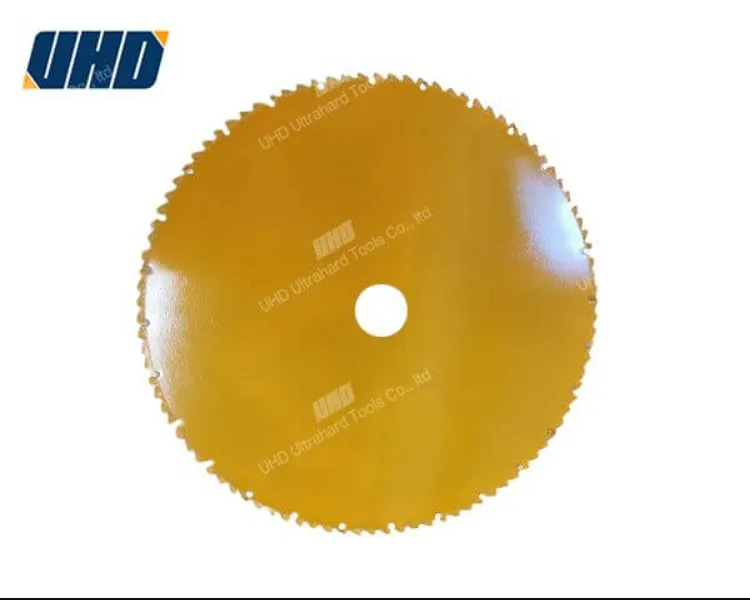
In the realm of industrial cutting, the ZS400H brazed diamond saw blade stands out as a game - changer. This article delves deep into its practical applications in cutting stainless steel and various hard materials, along with techniques to enhance cutting efficiency.
The ZS400H brazed diamond saw blade is designed to meet the special cutting requirements of multiple workpiece materials, including stainless steel, gray cast iron, ductile cast iron, and cemented carbide. Different materials have distinct impacts on the performance of cutting tools. For example, stainless steel has high toughness, which requires the saw blade to have excellent wear - resistance and sharpness. Gray cast iron, with its brittle nature, demands a saw blade that can handle sudden impacts without chipping. Ductile cast iron has better ductility, and the saw blade needs to maintain a stable cutting force. Cemented carbide is extremely hard, and the saw blade must have high - strength bonding and diamond particles.
Cutting parameters such as cutting line speed and feed rate are crucial for both cutting quality and saw blade life. When cutting stainless steel, a cutting line speed of around 30 - 40 m/s is generally recommended. If the speed is too low, the cutting efficiency will be significantly reduced, while an overly high speed may cause excessive wear on the saw blade. For the feed rate, it should be adjusted according to the thickness and hardness of the workpiece. A proper feed rate can ensure smooth cutting and reduce the risk of saw blade damage. For example, when cutting a 10 - mm - thick stainless steel plate, a feed rate of 0.5 - 1.0 mm/r is a good starting point. These parameters can be further optimized based on the specific cutting equipment and the quality requirements of the workpiece.
Proper installation and equipment centering are essential for the stable operation of the saw blade. Incorrect installation can lead to uneven stress distribution on the saw blade, resulting in premature wear and even breakage. When installing the saw blade, make sure it is tightly fixed and centered accurately. The equipment centering error should be controlled within 0.05 mm. This can be achieved through precise measurement and adjustment during the installation process. By ensuring correct installation and centering, vibrations can be minimized, and the saw blade's service life can be extended.
Regular maintenance is key to ensuring the long - term performance of the ZS400H brazed diamond saw blade. Rust prevention is an important aspect. After each use, the saw blade should be cleaned and dried, and a thin layer of anti - rust oil can be applied. Vibration monitoring is also necessary. Excessive vibration during cutting may indicate problems such as blade imbalance or improper installation. If abnormal vibration is detected, the operation should be stopped immediately for inspection. The replacement cycle of the saw blade depends on the cutting frequency and the type of workpiece. Generally, for continuous cutting of hard materials, the saw blade may need to be replaced every 200 - 300 hours of use.
Let's take a look at some real - world customer cases. A manufacturing company that used to cut stainless steel components with traditional saw blades was facing low efficiency and high costs. After switching to the ZS400H brazed diamond saw blade and following the recommended cutting parameters and maintenance methods, they achieved a 30% increase in cutting efficiency. Their production capacity increased from 100 parts per day to 130 parts per day, and the saw blade's service life was extended by about 20%. Another company that cuts cemented carbide workpieces reduced their tool - changing frequency by 40% after adopting the ZS400H saw blade, which significantly improved their overall production efficiency and reduced operating costs.
Q: What should I do if the saw blade makes a loud noise during cutting? A: A loud noise may be caused by incorrect installation, improper cutting parameters, or blade damage. First, check the installation to ensure the saw blade is properly centered and tightly fixed. Then, review the cutting parameters and adjust them if necessary. If the problem persists, inspect the saw blade for any visible damage.
Q: Can the ZS400H saw blade be used for wet cutting? A: Yes, the ZS400H saw blade can be used for wet cutting. Wet cutting can effectively reduce heat generation during cutting, which is beneficial for both the cutting quality and the saw blade's service life. However, make sure to use a suitable coolant and follow the relevant safety regulations.
If you're looking to revolutionize your industrial cutting process, enhance efficiency, and reduce costs, the ZS400H brazed diamond saw blade is the ideal choice. Don't miss out on this opportunity to upgrade your cutting technology. Explore the ZS400H Brazed Diamond Saw Blade Now!

 228
|
228
|
 diamond saw blade substrate material
vibration reduction in saw blades
construction site saw blade selection
brazed diamond blade performance optimization
cutting efficiency and blade life
diamond saw blade substrate material
vibration reduction in saw blades
construction site saw blade selection
brazed diamond blade performance optimization
cutting efficiency and blade life
 95
|
ZS400H diamond saw blade
industrial cutting solutions
brazed diamond blade performance
high manganese steel saw blade
eco-friendly cutting tools
94
|
Stainless steel cutting
Diamond saw blade
Brazed saw blade
Cutting parameter optimization
Industrial manufacturing cutting technology
95
|
ZS400H diamond saw blade
industrial cutting solutions
brazed diamond blade performance
high manganese steel saw blade
eco-friendly cutting tools
94
|
Stainless steel cutting
Diamond saw blade
Brazed saw blade
Cutting parameter optimization
Industrial manufacturing cutting technology
 61
|
ZS400H Brazed Diamond Saw Blade
industrial cutting solutions
high-performance cutting tools
61
|
ZS400H Brazed Diamond Saw Blade
industrial cutting solutions
high-performance cutting tools
 88
|
saw blade tooth arrangement optimization
noise reduction techniques for saw blades
vibration damping methods in cutting
diamond saw blade design principles
construction saw blade operational tips
88
|
saw blade tooth arrangement optimization
noise reduction techniques for saw blades
vibration damping methods in cutting
diamond saw blade design principles
construction saw blade operational tips









.png?x-oss-process=image/resize,h_600,m_lfit/format,webp)