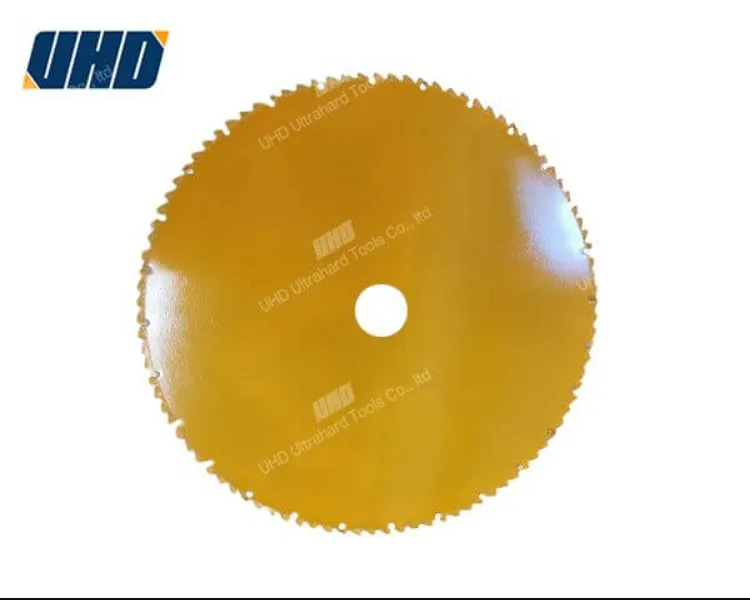
400mm brazed diamond saw blades are essential tools in the concrete cutting industry. Their core performance lies in excellent wear - resistance and high cutting efficiency. The manufacturing process of these saw blades involves advanced brazing technology. Compared with traditional welding processes, brazing can better bond the diamond particles to the saw blade matrix. For example, in a laboratory test, the bonding strength of diamond particles in brazed saw blades is about 30% higher than that in traditional welded saw blades, which significantly improves the overall performance of the saw blade.
The hardness of the material to be cut has a great impact on saw blade selection. When cutting hard materials such as high - strength concrete, a saw blade with a higher diamond concentration and better wear - resistance is required. For instance, for concrete with a compressive strength of over 40 MPa, a 400mm brazed diamond saw blade with a diamond concentration of 75% - 80% is recommended, while for softer concrete with a compressive strength of about 20 - 30 MPa, a saw blade with a diamond concentration of 60% - 70% can meet the requirements.
The cutting depth also affects the choice of saw blade. Generally, a deeper cutting depth requires a saw blade with better structural stability. A 400mm saw blade can usually achieve a cutting depth of up to 150mm. If the cutting depth exceeds 100mm, it is necessary to choose a saw blade with a thicker matrix and a more reasonable segment design to ensure the stability of the saw blade during cutting.
The operating environment, including temperature, humidity, and dust conditions, also plays a role in saw blade selection. In high - temperature environments, the cooling performance of the saw blade becomes crucial. In a dusty environment, a saw blade with better dust - removal design is needed to prevent dust from affecting the cutting performance and the service life of the saw blade.
In high - rise building demolition projects, 400mm brazed diamond saw blades are widely used. For example, in a 30 - story building demolition project, the saw blade was used to cut the concrete columns and beams. With its high cutting efficiency, a single saw blade could complete the cutting of about 5 - 8 cubic meters of concrete before significant wear occurred, greatly improving the demolition efficiency.
During floor treatment, such as removing old floor coatings or leveling uneven floors, 400mm saw blades can provide precise cutting. They can cut through the floor layer with a thickness of up to 50mm in one pass, ensuring a smooth and flat floor surface.
In bridge maintenance projects, the saw blade is used for cutting damaged concrete parts for repair. In a bridge deck repair project, the saw blade was able to accurately cut the damaged area, with a cutting accuracy of up to ± 2mm, which is crucial for ensuring the quality of bridge repair.
| Technology | Structural Stability | Service Life |
|---|---|---|
| Brazing | High. The brazed joint can better withstand the impact and vibration during cutting, reducing the risk of segment detachment. | Longer. On average, a brazed saw blade can have a service life 1.5 - 2 times longer than a traditionally welded saw blade. |
| Traditional Welding | Relatively low. The joint is more likely to be damaged under high - stress cutting conditions. | Shorter. Frequent replacement is required due to faster wear and segment detachment. |
When the height of the saw blade segment is reduced by about 30% - 40% of its original height, or when the diamond particles on the segment surface are severely worn and fall off, it indicates that the saw blade needs to be replaced. In addition, if the cutting efficiency drops significantly, such as the cutting speed decreasing by more than 20% compared with the initial speed, it may also be a sign of segment wear.
Proper cooling can effectively extend the service life of the saw blade. Water cooling is the most commonly used method. By spraying water on the saw blade during cutting, the temperature of the saw blade can be reduced by about 50% - 60%, which helps to prevent the diamond particles from being damaged by high - temperature oxidation.
Q: How often should I check the wear of the saw blade?
A: It is recommended to check the saw blade wear after every 8 - 10 hours of continuous use.
Q: Can I use the saw blade in a dry - cutting environment?
A: Although 400mm brazed diamond saw blades can be used in dry - cutting environments, it is not recommended. Dry - cutting will cause the saw blade temperature to rise rapidly, which will significantly reduce the service life of the saw blade. If dry - cutting is necessary, use a saw blade with special heat - resistant design and ensure proper ventilation.
Are you looking for a high - performance 400mm brazed diamond saw blade for your construction project? Click here to learn more about our products and make a smart choice for your business!