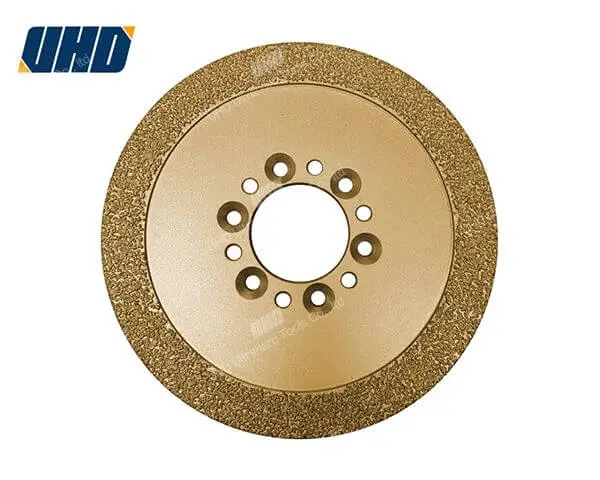
In the construction industry, the choice between dry cutting and wet cutting for 400mm brazed diamond saw blades is a critical decision that can significantly impact cutting efficiency, saw blade lifespan, and overall project outcomes. This article aims to provide a comprehensive guide to help construction workers and procurement decision - makers make informed choices.
Dry cutting is often preferred when there is a lack of on - site water sources or when quick, mobile cutting operations are required. For example, in some renovation projects where water supply is difficult to arrange, dry cutting can be a practical choice. However, dry cutting generates a large amount of dust, which may pose health risks to workers and cause environmental pollution. According to statistics, dry cutting can produce up to 80% more dust than wet cutting.
On the other hand, wet cutting uses water as a coolant and lubricant. It is suitable for cutting hard materials such as high - strength concrete. Wet cutting can reduce the temperature of the saw blade during the cutting process, thereby extending the saw blade's lifespan. Studies show that the lifespan of a saw blade used for wet cutting can be up to 30% longer than that of a saw blade used for dry cutting.
The brazing process plays a crucial role in the performance of diamond saw blades. Brazed diamond saw blades have a stronger bonding force between the diamond and the substrate, which can ensure better cutting performance and longer service life. In dry cutting, the high - temperature generated during the cutting process may cause the diamond to fall off if the brazing quality is not good. In wet cutting, the cooling effect of water can mitigate this problem to some extent.
When operating, for dry cutting, it is necessary to ensure that the cutting speed is appropriate. Too high a speed may cause excessive heat and damage the saw blade. For wet cutting, it is important to choose the right coolant. A good coolant can not only improve the cutting efficiency but also protect the saw blade. Some coolants can reduce the friction between the saw blade and the material by up to 20%.
Let's take a large - scale building foundation construction project as an example. In the area near the water source, wet cutting was used. The saw blade lasted for about 150 cutting operations, and the cutting surface was smooth with little dust. In the area far from the water source, dry cutting was used. The saw blade only lasted for about 100 cutting operations, and the dust was so large that workers had to wear protective equipment.
| Cutting Mode | Saw Blade Lifespan | Dust Generation | Cutting Surface Quality |
|---|---|---|---|
| Dry Cutting | About 100 operations | High (up to 80% more than wet cutting) | Relatively rough |
| Wet Cutting | About 150 operations | Low | Smooth |
We have prepared a practical judgment flowchart to help you quickly determine whether to choose dry cutting or wet cutting based on on - site water sources, material hardness, and processing requirements. By following this flowchart, you can make more scientific decisions.
In addition, proper maintenance of the saw blade is essential. After each use, clean the saw blade, especially for wet cutting. Remove any residue on the saw blade to prevent corrosion. Regularly check the sharpness of the saw blade and replace it in time when it becomes dull.
Our 400mm brazed diamond saw blades offer high cost - effectiveness and advanced technology. They are designed to meet the diverse needs of construction projects. Don't miss this opportunity to improve your cutting efficiency and saw blade lifespan. Download our judgment flowchart and consult us for procurement now!